

What Is a TOC Analyzer and Why Does It Matter?
Total Organic Carbon (TOC) is the most widely used surrogate parameter for measuring organic contamination in water. Whether you're running a pharmaceutical manufacturing facility, a semiconductor fab, a power plant, or a drinking water utility, the concentration of organic carbon in your process water directly affects both product quality and regulatory compliance.
A TOC analyzer — sometimes called a TOC meter, TOC tester, or total organic carbon analyzer — quantifies the amount of carbon bound in organic compounds dissolved or suspended in water. Results are typically expressed in:
µg/L (micrograms per liter) — used for ultrapure and pharmaceutical-grade water
mg/L (milligrams per liter) — used for drinking water, wastewater, and industrial process water
The United States Pharmacopeia (USP) Chapter <643> and the European Pharmacopoeia (EP) 2.2.44 both mandate TOC testing for:
Purified Water (PW): TOC limit ≤ 500 µg/L (0.5 ppm)
Water for Injection (WFI): TOC limit ≤ 500 µg/L (0.5 ppm)
Highly Purified Water (HPW): TOC limit ≤ 500 µg/L
Failure to meet these limits can result in batch rejection, regulatory citations (FDA 483 observations), and in worst cases, facility shutdowns. This makes selecting the right TOC water analyzer one of the most consequential instrumentation decisions in a pharmaceutical facility.
Understanding measurement principles helps you select the best TOC analyzer for your specific application:
Method | Detection Limit | Best For | Reagent Use |
UV Photocatalytic Oxidation | ≤ 1 ppb (µg/L) | Ultrapure water, pharma WFI, semiconductor | None |
UV + Persulfate Oxidation | ≤ 1 ppb | Pharmaceutical PW, low-matrix samples | Persulfate reagent |
High-Temperature Combustion (HTC) | 50 ppb–1 ppm | Wastewater, high-matrix samples | None |
Wet Chemical (Persulfate) | 10–50 ppb | General lab, environmental water | Persulfate + acid |
For pharmaceutical water, ultrapure water (UPW), deionized water, and water for electronics manufacturing, UV photocatalytic oxidation is the gold standard because:
No reagent consumption → zero daily chemical costs, no reagent waste disposal
No carrier gas required → simpler setup, lower operating expense
Sub-ppb detection limits → capable of measuring down to 0.1 µg/L
Non-destructive to the sample → minimal interference from sample matrix
Faster cycle times → analytical results in under 5 minutes
Key Insight: If your application involves pharmaceutical water, semiconductor ultrapure water, or power plant boiler feedwater, UV oxidation technology eliminates ongoing reagent costs that can add up to thousands of dollars per year with persulfate-based systems.
Match the instrument's range to your water quality:
Water Type | Typical TOC Range | Recommended Analyzer Range |
Water for Injection (WFI) | 10–500 µg/L | 0.1–1,000 µg/L |
Purified Water | 50–500 µg/L | 0.1–1,000 µg/L |
Ultrapure Water (UPW) | 1–50 µg/L | 0.1–100 µg/L |
Drinking Water | 1–5 mg/L | 0.1 µg/L–10 mg/L |
Wastewater | 5–500 mg/L | 1–1,000 mg/L |
Your TOC analyzer must support:
USP <643> System Suitability Test (SST) — verifies that the instrument can accurately measure the 1,4-benzoquinone response and sucrose standard
21 CFR Part 11 Compliance — electronic records and audit trail for FDA-regulated environments
GMP Data Integrity — password protection, user access levels, traceable data export
In-process monitoring and QC release testing both benefit from faster cycle times. Look for:
Cycle time ≤ 5 minutes for routine pharmaceutical water testing
Cycle time ≤ 3 minutes for high-throughput QC labs
Mode | Best Use Case | Key Feature |
Online / Continuous | CIP/SIP validation, distribution loop monitoring | Real-time TOC trending, alarm outputs |
Laboratory / Batch | QC release testing, stability studies, method validation | High-precision, multi-sample throughput |
Portable / Field | Remote sampling points, environmental compliance | Battery-powered, ruggedized design |
Many modern TOC analyzers — including the ERUN-SP3-J3 — support switchable online/offline dual modes, giving laboratories flexibility without purchasing two separate instruments.
Beyond purchase price, evaluate:
Reagent consumption (UV-only systems: zero reagent cost)
Lamp replacement frequency and cost
Calibration gas or standard solution requirements
Service contract and spare parts availability
Software license and upgrade costs
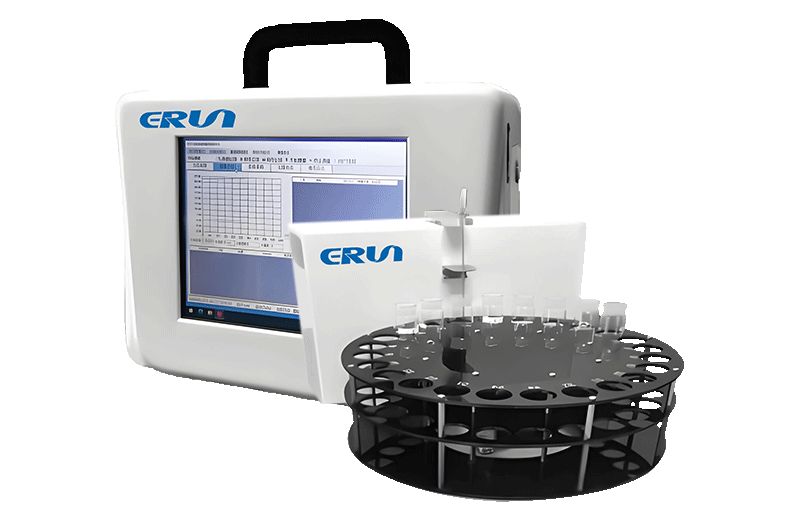
The ERUN-SP3-J3 is a UV photocatalytic oxidation TOC analyzer designed for high-purity water applications, manufactured by Xi'an Erun Environmental Protection Technology Group Co., Ltd. — a China-based instrumentation company specializing in water quality and gas analysis.
Product Page: ERUN-SP3-J3 TOC Analyzer (https://www.erunwas.com/products-detail/id-298.html)
Parameter | Specification |
TOC Measurement Range | 0.1 – 1,000.0 µg/L |
Conductivity Range | 0.055 – 6.000 µS/cm |
TOC Resolution | 0.1 µg/L |
Precision (RSD) | ≤ 3% |
Accuracy | ≤ ±5% |
Zero Drift | ±2%/day |
Span Drift | ±2%/day |
Analysis Cycle | ≤ 5 min (standard); ≤ 3 min (fast mode) |
Minimum Detection Limit | 1 ppb (µg/L) |
Sample Temperature | 0 – 100°C |
Operating Temperature | 0 – 40°C |
Relative Humidity | ≤ 90% RH |
Power Supply | AC 220V ±10%, 50Hz or DC 12V battery |
Power Consumption | 60 W |
Dimensions | 276 × 132 × 198 mm |
Weight | 5 kg |
Display | 8-inch color touchscreen |
The ERUN-SP3-J3 simultaneously measures:
TC — Total Carbon
TOC — Total Organic Carbon
TIC — Total Inorganic Carbon
NPOC — Non-Purgeable Organic Carbon
Conductivity
Temperature
This multi-parameter capability eliminates the need for separate instruments for conductivity monitoring — a significant advantage for pharmaceutical water system qualification.
Reagent-Free UV Photocatalytic OxidationThe ERUN-SP3-J3 uses UV light to catalytically oxidize organic compounds without requiring acid reagents, catalysts, or carrier gas. This translates to zero daily consumable costs and eliminates chemical waste disposal requirements — a major advantage for labs focused on sustainability and cost efficiency.
USP <643> and FDA 21 CFR Part 11 ComplianceThe analyzer supports the System Suitability Test (SST) protocol required by USP Chapter <643> for pharmaceutical water testing. Password protection and user access controls meet FDA 21 CFR Part 11 data integrity requirements, making it suitable for GMP-regulated environments.
Automatic Micro-Volume InjectionAutomated sample injection with precisely controlled volumes ensures reproducible results and prevents contamination between samples — critical for trace-level ppb analysis.
Dual Online/Offline Operating ModesSwitch seamlessly between:
Online mode — continuous real-time monitoring of pharmaceutical water distribution loops, with configurable alarm thresholds
Offline/lab mode — manual or automated batch sample analysis with an optional auto-sampler for unattended overnight runs
8-Inch Color Touchscreen with Chinese/English InterfaceThe large color touchscreen and intuitive menu-driven software minimize operator training time. The multilingual interface supports global deployment.
32 GB On-Board Storage with Unlimited Data HistoryAll measurements are stored with timestamp, user ID, and sample ID. Data can be exported via USB drive by date range, and the analyzer supports direct connection to thermal printers for GMP-compliant hard-copy records.
Optional Auto-Sampler for Unattended TestingPair the ERUN-SP3-J3 with the optional automatic sampler to run overnight batches without operator supervision — ideal for stability testing programs and validation studies.
Modular Architecture for Easy MaintenanceThe modular design allows field replacement of key components without returning the instrument for factory service, minimizing downtime.
Industry | Specific Application | Relevant Standard |
Pharmaceutical | Purified Water (PW) QC testing | USP <643>, EP 2.2.44 |
Pharmaceutical | Water for Injection (WFI) release | USP <643>, JP |
Pharmaceutical | Cleaning validation (CIP/SIP) rinse water | GMP guidelines |
Semiconductor | Ultrapure water (UPW) quality control | SEMI F57 |
Power Generation | Boiler feedwater / steam condensate | ASTM D4519 |
Drinking Water | Source water and treated water monitoring | EPA 415.3, ISO 8245 |
Electronics | PCB rinsing water quality | IPC standards |
Feature | ERUN-SP3-J3 | Typical High-End Brand |
Detection Limit | 1 ppb | 0.03–1 ppb |
Reagent Required | None | None or persulfate |
USP <643> Compliant | Yes | Yes |
21 CFR Part 11 | Yes | Yes |
Online + Offline Modes | Dual mode | Often separate models |
Conductivity Measurement | Built-in | Often add-on module |
Auto-Sampler Option | Available | Available |
Price Range | Budget-to-mid (competitive) | Mid-to-premium |
Bottom Line: For pharmaceutical QC labs, academic research, food & beverage water testing, and industrial ultrapure water monitoring that require USP/FDA compliance without a premium price tag, the ERUN-SP3-J3 delivers strong analytical performance and compliance-ready features.
Q: What is the TOC limit for pharmaceutical purified water?A: Both USP <643> and EP 2.2.44 specify a TOC limit of 500 µg/L (0.5 ppm) for both Purified Water (PW) and Water for Injection (WFI). Your TOC analyzer must be capable of accurate measurement at this level and below.
Q: What is the difference between TOC and COD testing?A: TOC (Total Organic Carbon) directly measures the carbon content of organic compounds and is faster, more sensitive, and more reproducible than COD (Chemical Oxygen Demand) tests, which require hazardous chemicals (dichromate) and are less suitable for clean water matrices.
Q: Do I need a System Suitability Test (SST) for pharmaceutical TOC testing?A: Yes. USP <643> requires that before each testing sequence, you verify instrument performance using a sucrose standard and a 1,4-benzoquinone standard. The ERUN-SP3-J3 supports this built-in SST workflow.
Q: Can I use a TOC analyzer for cleaning validation?A: Absolutely. TOC is the method of choice for cleaning validation of pharmaceutical equipment. Rinse water or swab extracts are analyzed for TOC to confirm that cleaning procedures have reduced organic contamination to acceptable levels (typically based on maximum allowable carryover calculations).
Q: What is the minimum detection limit I need for ultrapure water?A: For semiconductor UPW and pharmaceutical WFI, a detection limit of ≤ 1 µg/L (1 ppb) is generally required. The ERUN-SP3-J3 meets this threshold.
Q: Is the ERUN-SP3-J3 suitable for online continuous monitoring?A: Yes. The analyzer supports online monitoring mode with configurable high-alarm and low-alarm outputs. For continuous distribution loop monitoring, it can be paired with a sampling system that delivers conditioned water samples to the analyzer at defined intervals.
Application | Recommended Minimum Spec | ERUN-SP3-J3 Status |
Pharma PW / WFI | ≤1 ppb MDL, USP <643> SST | Meets requirement |
Semiconductor UPW | ≤1 ppb MDL | Meets requirement |
Drinking water | ≤10 µg/L, EPA 415.3 | Meets requirement |
Wastewater | ≤50 µg/L or mg/L range | Meets requirement |
Cleaning validation | ≤1 ppb MDL, 21 CFR Part 11 | Meets requirement |
The ERUN-SP3-J3 Total Organic Carbon Analyzer is a well-specified, compliance-ready instrument suited to pharmaceutical water testing, ultrapure water quality control, and a broad range of industrial water monitoring applications. Its reagent-free UV oxidation technology, built-in conductivity measurement, dual online/offline operating modes, and 21 CFR Part 11-ready data management make it a compelling option for labs seeking high performance without the premium cost of European or US-brand instruments.
Learn more and request a quote: ERUN-SP3-J3 TOC Analyzer — Erun Environmental (https://www.erunwas.com/products-detail/id-298.html)