


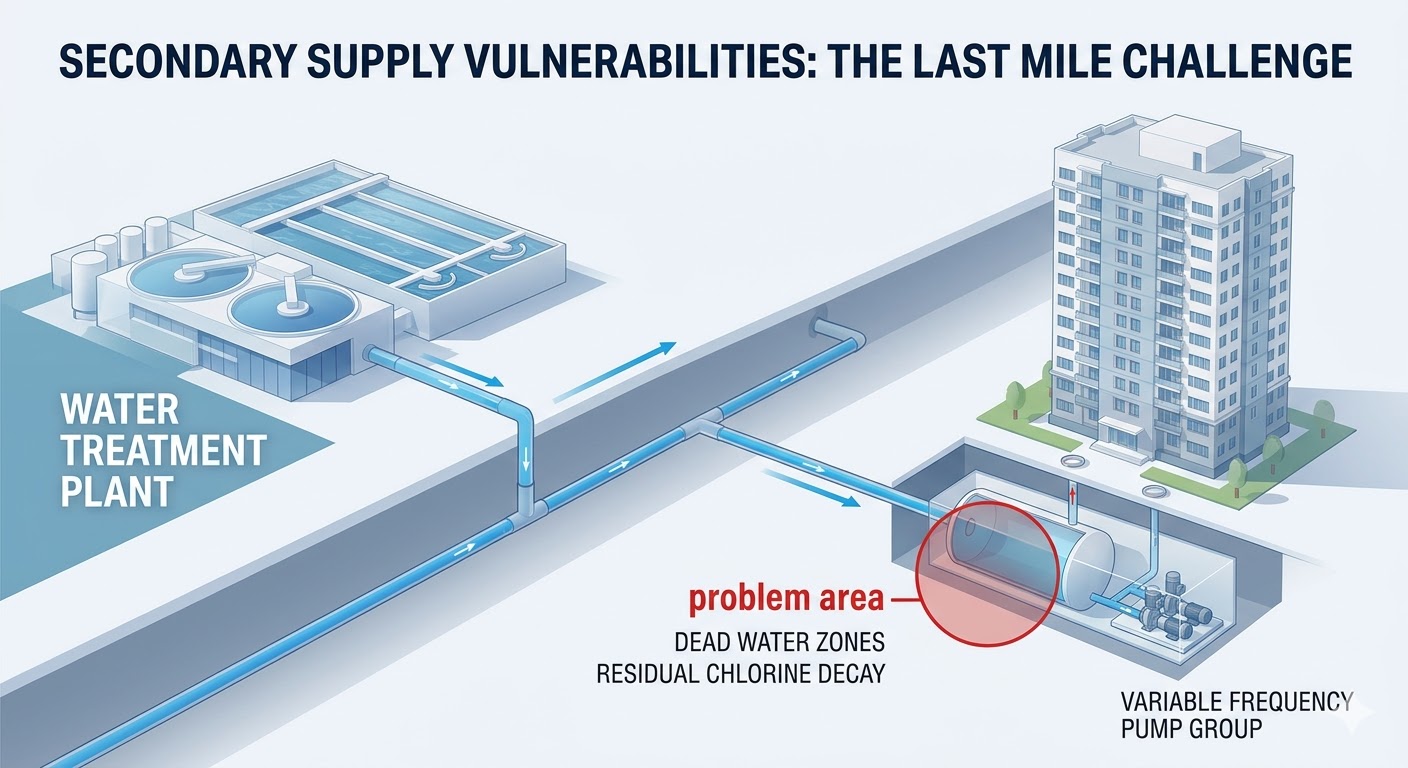
In the process of urbanization, the "last mile" of water delivery—the Secondary Water Supply System (including storage tanks, high-level cisterns, and variable frequency pump groups)—is often the most vulnerable link in water quality safety.
Due to long retention times and enclosed environments, water quality is highly susceptible to "biochemical rebound."
1. Residual Chlorine Decay and Nitrification:
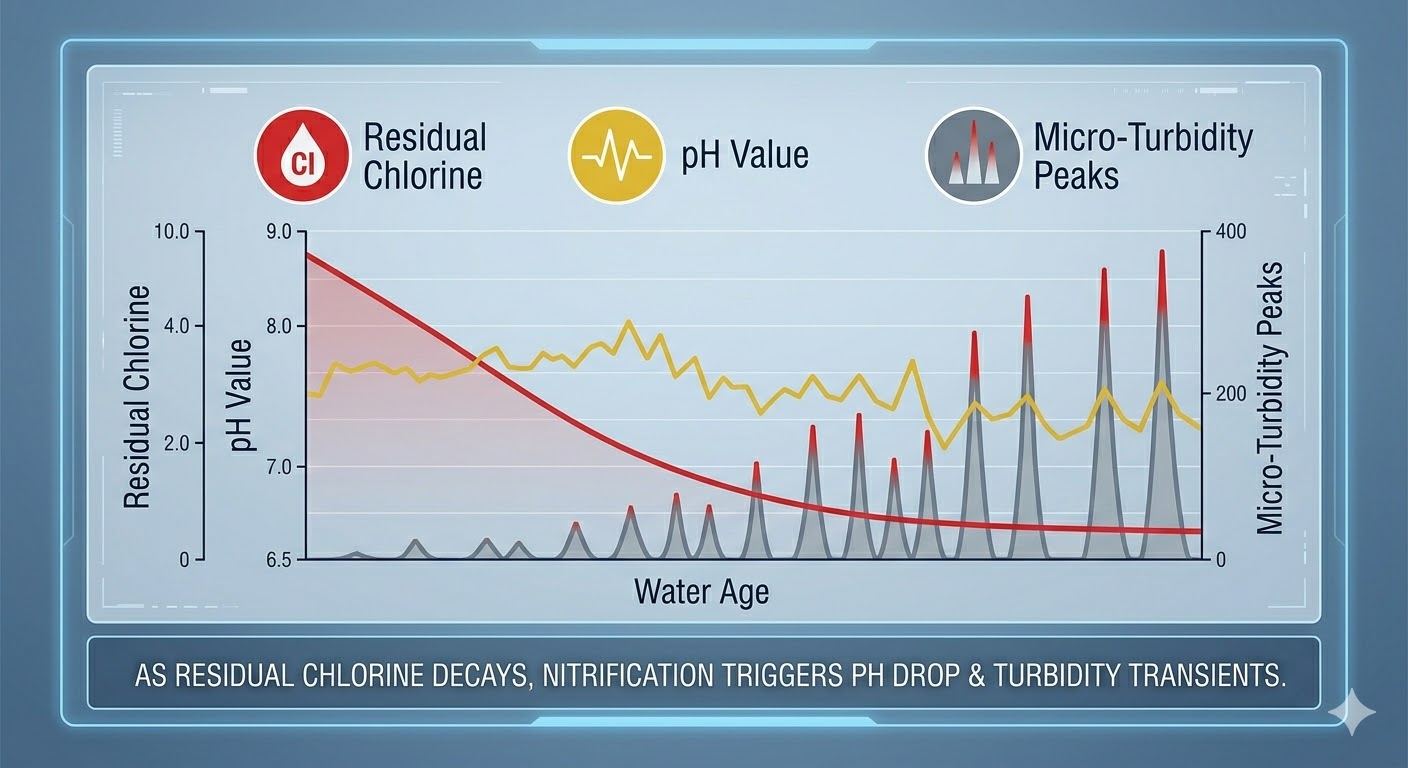
As "Water Age" increases in storage tanks, residual chlorine decays linearly due to evaporation and organic degradation. In systems using chloramination, insufficient residual chlorine can trigger nitrification, leading to elevated nitrite levels and a drop in pH, which directly corrodes metal pipe networks.
2. Sediment Accumulation and Turbidity Transients:
Frequent starts and stops of pump groups change flow velocity and direction, scouring "biofilms" and rust layers from pipe walls. These micro Turbidity Peaks not only affect taste but also act as carriers for bacteria, weakening the effectiveness of disinfectants.
3. Dissolved Oxygen (DO) and Reductive Substances:
Organic matter accumulation at the bottom of tanks consumes dissolved oxygen, creating a reductive environment. This can cause the precipitation of heavy metal ions like iron and manganese, resulting in "red water" or unpleasant odors.
Traditional laboratory sampling modes have a significant time lag. For "instantaneous pollution" common in secondary supply (such as backflow contamination or pipe bursts), by the time lab results are available, the contaminated water may have already reached consumers' homes.
To address these complex conditions, the ERUN-SP9 is not just a collection of sensors; it provides a real-time "health check" through multi-parameter correlation:
Simultaneous Multi-Parameter Monitoring: The ERUN-SP9 monitors pH, Conductivity, Dissolved Oxygen, Temperature, and Turbidity simultaneously. By analyzing minor deviations in pH and conductivity, technicians can quickly determine if external sources (like firewater or reclaimed water) have caused backflow contamination.
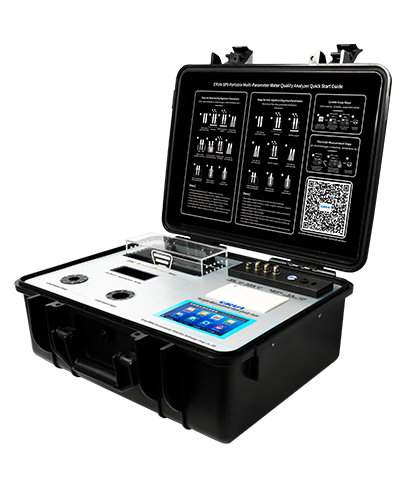
Digital Anti-Interference Technology: Pump rooms are typically filled with high-frequency electromagnetic interference from variable frequency drives. The ERUN-SP9 utilizes advanced digital sensor technology, converting analog signals within the probe itself to ensure stable and precise measurements of conductivity and ORP in high-voltage environments.
Rapid Field Warning: With its excellent thermal compensation algorithm, the ERUN-SP9 responds quickly to temperature changes in deep-buried pipes or condensate water, helping technicians identify risk points immediately on-site.
Data Traceability: The instrument's large internal memory supports data export, providing a foundation for building a "Water Quality Fingerprint Database." Analyzing historical fluctuation curves allows for the scientific setting of thresholds for automated dosing systems.
Drinking water safety monitoring is shifting from the lab to "real-time on-site." By utilizing high-integration digital instruments like the ERUN-SP9, water utilities can not only improve inspection efficiency but also pre-emptively warn of pollution through data anomalies, guarding the final line of public health defense.