


Ensuring safe drinking water requires precise monitoring of disinfectants, making how to measure residual chlorine a critical question for water professionals and regulators. Residual chlorine plays a vital role in maintaining microbiological safety throughout water distribution systems. Global standards, including those from the World Health Organization, the Safe Drinking Water Act, and GB 5749-2022, emphasize maintaining appropriate chlorine levels to balance effective disinfection with consumer safety.
Residual chlorine refers to the amount of chlorine remaining in water after the disinfection process. It ensures continuous protection against microbial contamination during storage and distribution. Insufficient levels may allow bacterial regrowth, while excessive chlorine can lead to unpleasant taste, odor, and potential health concerns.
Regulatory agencies typically define acceptable residual chlorine ranges, often between 0.2–1.0 mg/L depending on local standards and system conditions. Accurate measurement is therefore essential for compliance, operational control, and public health protection.
The DPD (N,N-diethyl-p-phenylenediamine) method is one of the most widely used techniques. It involves adding a reagent to the water sample, producing a pink color proportional to the chlorine concentration.
Advantages:
High sensitivity and accuracy
Suitable for both free and total chlorine
Widely accepted in regulatory standards
Limitations:
Requires proper reagent handling
Results may be affected by sample interference
This method is recognized in many international testing protocols and is commonly used in portable and laboratory instruments.
Amperometric titration measures chlorine concentration by detecting electric current changes during a chemical reaction.
Advantages:
high accuracy
Suitable for continuous monitoring systems
Limitations:
Requires specialized equipment
More complex operation
This method is typically used in large-scale water treatment facilities and research laboratories.
Simple test kits and strips provide a quick estimation of residual chlorine levels through color comparison.
Advantages:
Easy to use
Low cost
Ideal for field screening
Limitations:
Lower precision
Subjective interpretation
These methods are suitable for preliminary checks but are not recommended for compliance testing.
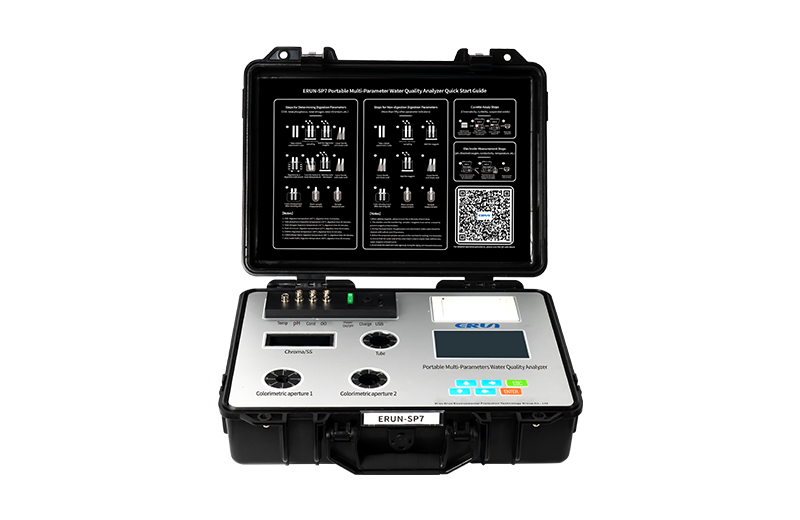
Modern digital instruments combine the DPD method with optical detection, offering accurate and user-friendly solutions. A representative example is the ERUN-SP7-K6 Portable Residual Chlorine Water Quality Meter by Erun Environmental Protection.
This device uses an advanced colorimetric method with optoelectronic technology, achieving a measurement accuracy of ±0.01 mg/L and a range of 0.02–10.00 mg/L. Its optical stability (≤0.002A/20min) ensures consistent performance, even during extended field operations.
The ERUN-SP7-K6 is designed for on-site testing across municipal water systems, food processing, healthcare, and industrial applications. Features such as a large LCD screen, automatic wavelength selection, built-in storage and printing, and an IP65-rated durable structure make it highly reliable in demanding environments. With low power consumption and a standby time of up to six months, it provides a practical solution for continuous water quality monitoring.
Method | Accuracy | Speed | Application |
DPD Colorimetric | High | Fast | Lab & Field |
Amperometric Titration | Very High | Moderate | Industrial |
Test Kits/Strips | Low | Very Fast | Quick Screening |
Digital Colorimeters | High | Fast | Field Monitoring |
Reliable results depend not only on the method but also on proper testing procedures. Samples should be analyzed immediately after collection to prevent chlorine loss. Testing environments must avoid direct sunlight, vibration, and electromagnetic interference, especially when using optical instruments.
Calibration and maintenance of equipment are equally important. Instruments should be regularly checked using standard solutions to ensure accuracy. Operators should also follow standardized procedures aligned with WHO, SDWA, and GB 5749-2022 requirements to maintain consistency and compliance.
Accurate monitoring of disinfectant levels is essential for ensuring safe and compliant water systems. Understanding how to measure residual chlorine allows water professionals to select appropriate methods, maintain regulatory standards, and protect public health. With advancements in portable testing technologies, achieving precise and efficient chlorine measurement has become more accessible than ever.