


Ensuring safe drinking water requires close monitoring of physical and chemical indicators, among which turbidity plays a critical role. Acceptable turbidity levels in drinking water are not only a measure of water clarity but also an important indicator of potential microbial contamination and treatment efficiency. Understanding regulatory limits and applying accurate testing methods are essential for water utilities, laboratories, and industrial users.
Turbidity refers to the cloudiness or haziness of water caused by suspended particles such as silt, organic matter, microorganisms, and inorganic substances. It is typically measured in NTU (Nephelometric Turbidity Units) using light-scattering techniques.
High turbidity levels can shield harmful microorganisms from disinfection processes, reducing the effectiveness of chlorine or other disinfectants. This increases the risk of waterborne diseases and compromises public health. In addition, turbidity affects the aesthetic quality of drinking water, making it less acceptable to consumers.

Different regulatory frameworks define acceptable turbidity levels based on health protection and treatment performance. The following table summarizes key guidelines:
Standard / Regulation | Acceptable Turbidity Level |
WHO Guidelines for Drinking-water Quality | < 5 NTU (recommended), ideally < 1 NTU |
Safe Drinking Water Act (SDWA, U.S. EPA) | ≤ 0.3 NTU (95% of samples), never > 1 NTU |
GB 5749-2022 (China) | ≤ 1 NTU for drinking water |
The WHO emphasizes that turbidity should be as low as possible, particularly below 1 NTU, to ensure effective disinfection. Under the SDWA, stricter operational limits apply to treated water, reflecting advanced treatment expectations. GB 5749-2022 also sets a maximum limit of 1 NTU, aligning with international best practices.
These standards highlight that maintaining low turbidity is not only a regulatory requirement but also a critical factor in ensuring microbiological safety.
Accurate turbidity measurement depends on reliable analytical methods and proper instrumentation. The most widely used technique is the nephelometric (light scattering) method, which detects the intensity of light scattered by particles in water.
Based on ISO and EPA-approved principles
Measures scattered light at a 90° angle
Provides high sensitivity for low turbidity levels
Historically used for rough estimation
Lack precision and are no longer suitable for regulatory compliance
Continuous real-time measurement
Widely used in water treatment plants
Enables rapid response to fluctuations
For laboratory and field applications, portable turbidity meters are widely preferred due to their flexibility and ease of use.
Several factors can influence turbidity readings and should be carefully controlled:
Air bubbles in the sample can scatter light and produce false readings
Color and dissolved substances may interfere with light transmission
Instrument calibration must be performed regularly using standard solutions
Environmental conditions, such as vibration or direct sunlight, can impact measurement stability
Proper sample handling and adherence to standard procedures are essential to ensure reliable results.
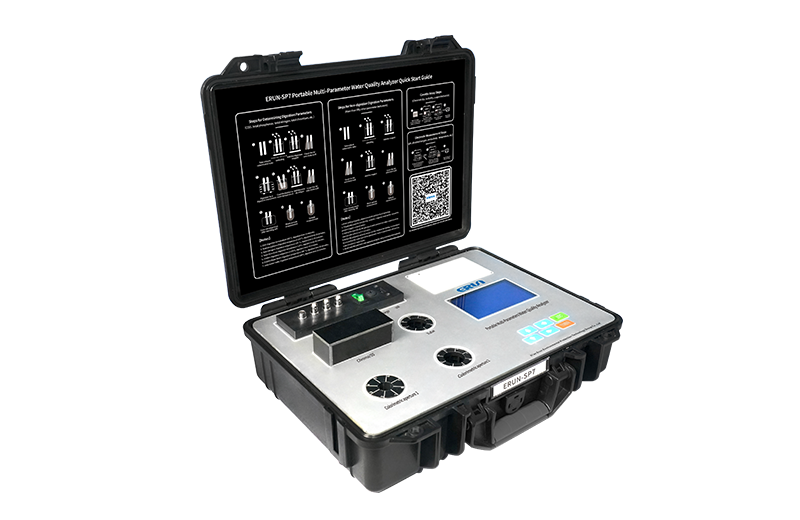
For professionals who require accurate and efficient field testing, the Portable water quality turbidity tester ERUN-SP7-T4 by Erun Environmental Protection offers a practical solution.
This instrument uses the scattering method to measure turbidity across a range of 0.00–400 NTU, making it suitable for drinking water, surface water, and industrial wastewater applications. With a minimum resolution of 0.01 NTU and an error margin of ≤±2%, it delivers precise and consistent results aligned with regulatory requirements.
The device is designed for usability and performance, featuring a color touch screen, built-in operation guidance, and bilingual interface support. Advanced functions such as automatic data backup, storage of up to 100,000 records, and one-click data recovery enhance operational efficiency. Its stability is further supported by low drift (<0.1 NTU per hour) and adjustable signal strength, ensuring reliable measurements even in demanding environments.
Such portable instruments are particularly valuable for on-site inspections, compliance monitoring, and rapid decision-making in water quality management.
Maintaining acceptable turbidity levels requires a combination of effective treatment processes and accurate monitoring. Filtration, coagulation, and sedimentation are commonly used to reduce turbidity before disinfection. Continuous measurement ensures that these processes are functioning as intended and that water quality remains within regulatory limits.
Water professionals must also integrate routine testing with advanced analytical tools to detect deviations early and prevent potential risks. Reliable data supports