


Understanding alkalinity vs pH in water is essential for anyone involved in drinking water production, municipal supply management, laboratory analysis, or industrial water treatment. Although these two parameters are often mentioned together, they measure fundamentally different chemical properties. Confusing them can lead to improper chemical dosing, unstable distribution systems, and inefficient disinfection.
A clear distinction between alkalinity and pH not only improves operational control but also ensures compliance with major regulatory frameworks such as the World Health Organization Guidelines for Drinking-water Quality, the Safe Drinking Water Act in the United States, and China’s GB 5749-2022.
pH measures the concentration of hydrogen ions (H⁺) in water and indicates how acidic or alkaline the water is at a given moment. The pH scale ranges from 0 to 14:
pH < 7: acidic
pH = 7: neutral
pH > 7: alkaline
In drinking water systems, pH influences corrosion potential, disinfection efficiency, and chemical stability.
According to WHO guidelines, pH typically falls within 6.5–8.5 for acceptable drinking water quality, primarily to prevent corrosion and scaling. Similarly, under the Safe Drinking Water Act, U.S. utilities control pH as part of corrosion control treatment requirements. China’s GB 5749-2022 also specifies a pH range for potable water to maintain system stability.
pH can change rapidly. A small addition of acid or base may significantly shift the reading, especially in water with low buffering capacity.
Alkalinity measures water’s ability to neutralize acids. It reflects the buffering capacity of water rather than its current acidity level. In most natural waters, alkalinity is mainly derived from:
Bicarbonate (HCO₃⁻)
Carbonate (CO₃²⁻)
Hydroxide (OH⁻)
Unlike pH, alkalinity does not indicate how alkaline water “is” at a specific moment. Instead, it shows how resistant the water is to pH changes.
Alkalinity is typically expressed as mg/L of CaCO₃. While major regulations do not establish a strict health-based limit for alkalinity, it plays a central role in operational control, especially in coagulation, lime softening, and corrosion management.
The distinction becomes clearer when viewed side by side:
Parameter | pH | Alkalinity |
What it measures | Acidity/alkalinity level at a moment | Acid-neutralizing capacity |
Unit | pH scale (0–14) | mg/L as CaCO₃ |
Stability | Can change quickly | Changes gradually |
Regulatory focus | Often specified range | Operational control parameter |
Impact | Corrosion, disinfection efficiency | Buffering, stability, dosing control |
Water can have a neutral pH but low alkalinity, meaning its pH may fluctuate easily. Conversely, water with moderate alkalinity can resist sudden pH changes even if acid is introduced.
Corrosion in distribution systems depends heavily on both pH and alkalinity. Utilities often use the Langelier Saturation Index (LSI), which incorporates alkalinity as a critical variable. Low alkalinity reduces buffering capacity, increasing the risk of pipe corrosion and potential metal leaching.
Chlorine effectiveness varies with pH. At higher pH levels, hypochlorous acid converts to the less effective hypochlorite ion. If alkalinity is high, pH becomes more resistant to adjustment, affecting oxidation reactions and disinfectant optimization.
Aluminum and iron-based coagulants consume alkalinity during hydrolysis. Insufficient alkalinity can cause a drop in pH, reducing coagulation efficiency and destabilizing treatment processes.
Water with adequate alkalinity maintains consistent pH during transport, protecting infrastructure and maintaining aesthetic quality.
International standards emphasize pH control because of its direct effect on health-related parameters and infrastructure. The WHO Guidelines recommend maintaining a stable pH range for palatability and corrosion control. Under the Safe Drinking Water Act, pH monitoring is integrated into corrosion control programs. China’s GB 5749-2022 similarly establishes pH limits to ensure safe and stable drinking water.
Although alkalinity is not assigned a strict maximum contaminant level in these frameworks, it is implicitly recognized as an essential parameter for achieving compliance with pH and corrosion-related requirements.
Given its operational importance, accurate alkalinity measurement is critical for laboratories and field technicians. Portable spectrophotometric systems offer a practical solution for real-time monitoring.
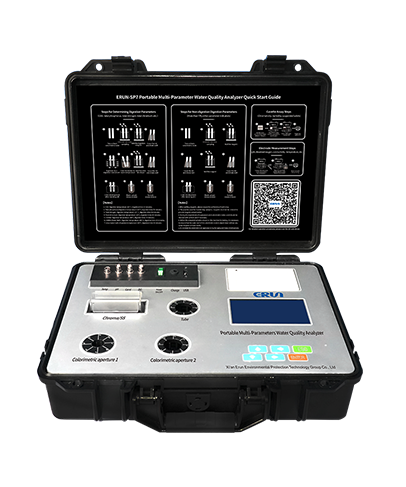
The ERUN-SP7-A3 Portable Water Quality Alkalinity Tester is designed for rapid and precise total alkalinity detection using spectrophotometry. With a measuring range of 0.00–1000.0 mg/L and accuracy within ±5%, it supports both municipal water plants and academic laboratories.
Its large bilingual color touch screen, data storage capacity of 100,000 records, automatic backup, and curve customization features make it suitable for field deployment. The compact suitcase design allows on-site testing without sacrificing analytical reliability, while stability drift remains below 0.002A under proper operating conditions.
Reliable instrumentation ensures that alkalinity data supports informed pH control strategies, chemical dosing adjustments, and compliance documentation.
Alkalinity vs pH in water is not a matter of choosing one parameter over the other. They work together to determine water stability, treatment efficiency, and regulatory compliance. pH reveals the current condition of water, while alkalinity determines how that condition responds to change.
For water utilities, laboratories, and industrial operators, understanding and monitoring both parameters ensures safer distribution systems, optimized treatment performance, and alignment with global drinking water standards.