


Water disinfection is designed to inactivate pathogenic microorganisms and ensure microbiological safety at the consumer’s tap. Yet even when the correct disinfectant dose is applied, treatment performance can be compromised by one critical factor: suspended particles in the water. Turbidity impact on disinfection is a central concern in drinking water treatment because particles can shield microorganisms, increase disinfectant demand, and reduce overall inactivation efficiency. International regulatory frameworks recognize this relationship and establish turbidity control as a prerequisite for effective microbial protection.
Turbidity refers to the cloudiness of water caused by suspended solids such as clay, silt, organic matter, algae, and microorganisms. It is typically measured in NTU (Nephelometric Turbidity Units) using a light-scattering method.
High turbidity interferes with disinfection in several ways:
Particle shielding effect: Microorganisms can attach to or become embedded within particles, physically protecting them from disinfectants such as chlorine, ozone, or chlorine dioxide.
Increased disinfectant demand: Organic and inorganic particles react with disinfectants, reducing the available free residual needed for pathogen inactivation.
Formation of by-products: Elevated organic matter can promote disinfection by-product (DBP) formation when chemical disinfectants are applied.
Reduced UV penetration: In UV disinfection systems, suspended particles scatter and absorb UV light, lowering microbial inactivation efficiency.
The relationship between turbidity and pathogen removal has been demonstrated in both laboratory and field studies. Even short-term turbidity spikes may allow pathogens such as Cryptosporidium or Giardia to pass through treatment barriers if filtration and coagulation are not optimized.

International standards emphasize turbidity as a critical operational parameter linked directly to disinfection performance.
The WHO recommends that turbidity be kept as low as possible, particularly before disinfection. For effective chlorination, turbidity ideally should be below 1 NTU and preferably below 0.5 NTU to ensure adequate microbial inactivation and residual maintenance. The guidelines clearly associate low turbidity with improved pathogen removal and disinfection reliability.
Under the SDWA, the U.S. Environmental Protection Agency (EPA) establishes turbidity performance requirements for public water systems, especially those using surface water. Filtration systems must typically maintain turbidity below 0.3 NTU in at least 95% of monthly measurements. This requirement exists because turbidity is considered an indicator of filtration efficiency and, by extension, disinfection effectiveness.
China’s national standard for drinking water quality sets turbidity limits for finished water, generally not exceeding 1 NTU under conventional conditions. The standard aligns with global practice by emphasizing that turbidity must be controlled to safeguard downstream disinfection processes and microbial safety.
The consistent message across these frameworks is clear: turbidity is not merely an aesthetic parameter; it is directly tied to microbiological risk control.
The operational relationship between turbidity and disinfection can be summarized as follows:
Turbidity Level | Operational Impact | Disinfection Consequence |
< 0.5 NTU | Efficient filtration | Optimal disinfectant contact and pathogen inactivation |
0.5–1 NTU | Acceptable control | Slightly increased disinfectant demand |
> 1 NTU | Particle breakthrough | Reduced inactivation, possible pathogen survival |
> 5 NTU | High particle load | Significant shielding, elevated microbial risk |
In surface water systems, storm events often increase turbidity dramatically. Without rapid adjustment in coagulation, sedimentation, and filtration processes, disinfectant doses alone cannot compensate for the shielding effect of suspended solids.
For utilities using UV disinfection, turbidity above 1 NTU may significantly reduce UV transmittance. In chlorination systems, high turbidity correlates with higher chlorine demand and unstable residuals within distribution networks.
Because turbidity can fluctuate rapidly, continuous or high-frequency monitoring is essential. Operational staff rely on turbidity data to:
Adjust coagulant dosage
Optimize filter backwashing cycles
Control disinfectant dosing
Ensure compliance with regulatory standards
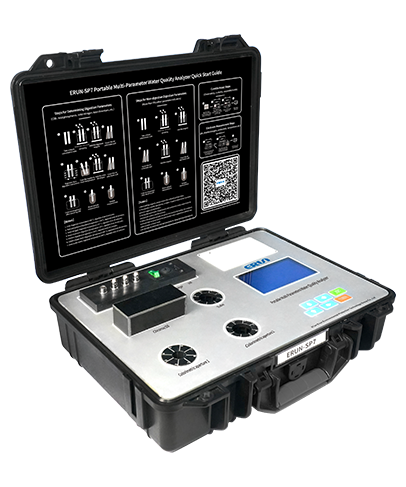
Accurate measurement requires reliable instrumentation. The ERUN-SP7-T4 Portable Water Quality Turbidity Tester from Erun Environmental Protection is designed specifically for this purpose. Using the scattering method, it measures turbidity from 0.00 to 400 NTU with a minimum resolution of 0.01 NTU and an error range of ≤±2%.
Its color touch screen, built-in operation guide, bilingual interface, and storage capacity of 100,000 records support field operations in municipal plants, industrial wastewater systems, and surface water monitoring. With drift per hour below 0.1 NTU and repeatability within ±2%, it provides stable data necessary for operational decision-making. The 3,500 calibration curves and automatic backup function further enhance reliability in demanding treatment environments.
Effective turbidity monitoring ensures that disinfection barriers remain intact and that corrective actions can be implemented before microbial risks escalate.
Modern drinking water treatment follows a multi-barrier approach: source protection, coagulation–flocculation, sedimentation, filtration, and disinfection. Turbidity control plays a foundational role in this system. When filtration performs well and turbidity remains consistently low, disinfectants achieve their intended microbial log reductions with predictable residual levels.
Utilities that maintain turbidity below regulatory thresholds demonstrate stronger compliance with microbial standards and reduced likelihood of waterborne outbreaks. Investment in real-time turbidity monitoring, preventive maintenance, and staff training supports long-term treatment stability.
The evidence across global standards and operational practice reinforces that turbidity impact on disinfection is both scientifically established and regulatorily recognized. Maintaining low turbidity is not simply a matter of clarity; it is a decisive factor in achieving reliable microbial safety in drinking water systems.