


Safe drinking water depends not only on microbiological safety but also on effective control of dissolved chemical constituents that influence taste, infrastructure durability, and regulatory compliance. Among these parameters, portable chloride ion testing plays an essential role in evaluating water quality and identifying potential risks within drinking water systems. As monitoring requirements expand beyond centralized laboratories, chloride ion testing for drinking water using portable technologies has become increasingly important for utilities, regulators, and environmental professionals.
International frameworks such as the WHO Guidelines for Drinking-water Quality and regulatory mechanisms established under the Safe Drinking Water Act (SDWA) recognize chloride ions as key indicator parameters. Although chloride ions are not typically associated with acute health effects at common concentrations, elevated levels can signal contamination pathways, promote corrosion, and undermine long-term water system reliability. Accurate and timely drinking water chloride monitoring is therefore a fundamental component of modern water quality management.
Chloride ions are naturally present in surface water and groundwater due to mineral dissolution, soil interactions, and atmospheric deposition. Human activities such as road de-icing, industrial discharge, seawater intrusion, and wastewater leakage can significantly increase chloride concentrations in drinking water sources.
High chloride ion concentration in drinking water can accelerate corrosion of metal pipes, valves, and storage tanks. This corrosion not only shortens infrastructure lifespan but can also lead to secondary contamination from metals released into the water. From a sensory perspective, excessive chloride may impart a salty taste that reduces consumer acceptance.
Both the WHO drinking water chloride guideline and SDWA secondary contaminant recommendations emphasize chloride as an operational and aesthetic indicator. These frameworks highlight the importance of routine chloride ion water quality testing to support preventive maintenance and safeguard distribution systems.
Conventional chloride analysis methods, including titration and laboratory-based spectrophotometry, remain analytically robust but present practical limitations. Sample transport delays, laboratory turnaround times, and the need for controlled environments restrict their usefulness for rapid decision-making.
In emergency scenarios, remote water systems, or routine field inspections, delays in obtaining chloride results can hinder timely corrective actions. These constraints have driven demand for field chloride testing equipment capable of delivering accurate results directly at the sampling point.
Portable chloride ion testing addresses these challenges by combining analytical reliability with operational flexibility. On-site testing enables immediate evaluation of chloride levels, supports trend analysis, and improves responsiveness to emerging water quality issues.
Key advantages include:
lReal-time measurement of chloride ion concentration in drinking water
lReduced risk of sample contamination or degradation
lEnhanced spatial coverage across distribution networks
lImproved documentation for compliance audits
By supporting proactive monitoring strategies, on-site chloride testing strengthens alignment with WHO and SDWA principles focused on system-wide risk management.
A high-quality portable chloride ion tester must deliver consistent accuracy while withstanding demanding field conditions. The ERUN-SP8-ASC-C4 Portable Chloride Ion Water Quality Tester is designed specifically to meet these requirements for drinking water applications.
The instrument measures chloride ions using characteristic absorption and emission behavior under monochromatic light irradiation. The emitted light intensity is directly proportional to chloride ion concentration, ensuring stable and repeatable readings suitable for regulatory and operational use.
With a measurement range of 3–1000 mg/L, a resolution of 0.01 mg/L, and robust IP-rated protection, this portable water quality tester for chloride supports reliable monitoring across diverse environments.
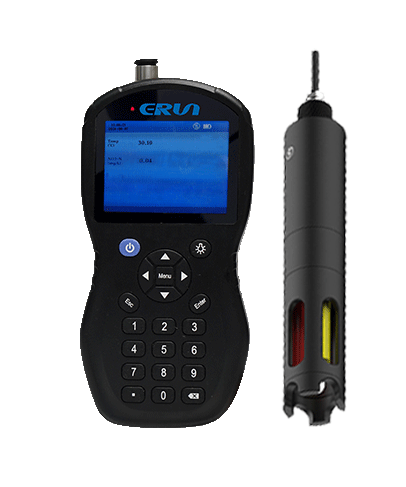
The ERUN-SP8-ASC-C4 integrates ergonomic design, intelligent sensor recognition, and advanced data management features. Automatic sensor identification and parameterized calibration reduce operator error and improve measurement consistency during chloride ion testing for drinking water.
Built-in data storage exceeding 100,000 records allows long-term trend analysis and seamless compliance reporting. USB data export and rechargeable battery operation further enhance its suitability for continuous field deployment.
By enabling accurate drinking water chloride monitoring at the point of use, the ERUN-SP8-ASC-C4 helps water professionals detect risks early, protect infrastructure, and maintain confidence in drinking water quality across regulatory and operational contexts.