


Ensuring safe and reliable water quality is a global priority, whether for municipal drinking water systems, industrial processes, or food and pharmaceutical production. Among the many water quality parameters, chlorine residual detection plays a decisive role. Chlorine is widely used as a disinfectant, but its concentration must be carefully controlled: too little reduces disinfection effectiveness, while too much can cause taste issues, corrosion, or even health risks. Understanding how residual chlorine is measured, why it matters, and how to apply best testing practices is essential for anyone involved in water management.
Residual chlorine refers to the amount of chlorine remaining in water after the disinfection process is complete. This remaining chlorine continues to protect water from microbial contamination as it travels through pipelines and storage systems.
There are two main forms:
l Free residual chlorine: Includes hypochlorous acid (HOCl) and hypochlorite ion (OCl⁻), which are highly effective disinfectants.
l Combined residual chlorine: Formed when chlorine reacts with ammonia or nitrogen compounds, creating chloramines.
Both forms are monitored depending on application requirements, regulatory standards, and water treatment goals.
Residual chlorine acts as a safety barrier against bacteria, viruses, and pathogens in drinking water. Continuous monitoring ensures that disinfection remains effective throughout the entire distribution network.
Most national and international standards specify acceptable chlorine residual ranges. Accurate detection helps utilities and industries stay compliant with environmental and health regulations.
In food and beverage production, pharmaceuticals, and petrochemical facilities, chlorine levels must be tightly controlled to avoid product contamination or equipment damage.
Excessive chlorine can negatively affect taste and odor, while also accelerating corrosion in pipes and equipment. Proper detection supports balanced water treatment.
Several methods are used to measure residual chlorine, each with distinct advantages:
This is one of the most widely adopted techniques. A reagent reacts with chlorine in the sample to produce a color change. The intensity of the color corresponds to the chlorine concentration and is measured optically.
Advantages:
l High accuracy
l Suitable for field and laboratory testing
l Easy to interpret results
These sensors measure chlorine based on electrochemical reactions at the electrode surface.
Advantages:
l Continuous online monitoring
l Minimal reagent use
Often used for quick checks, these rely on visual comparison of color changes.
Advantages:
l Low cost
l Simple operation
Limitations: Lower precision and subject to human interpretation.
Among these options, colorimetric detection remains the preferred choice when accuracy, repeatability, and regulatory acceptance are required.
To ensure reliable and meaningful results, the following best practices are recommended:
Field inspections, regulatory audits, and industrial process control often require different accuracy levels. Choose a method that matches your operational needs.
Using EPA or internationally recognized standard methods improves result consistency and regulatory acceptance.
Optical stability, temperature control, and repeatability are critical for colorimetric measurements.
Storing historical data allows trend analysis, compliance reporting, and early detection of system issues.
Even advanced instruments should be periodically checked to ensure long-term accuracy.
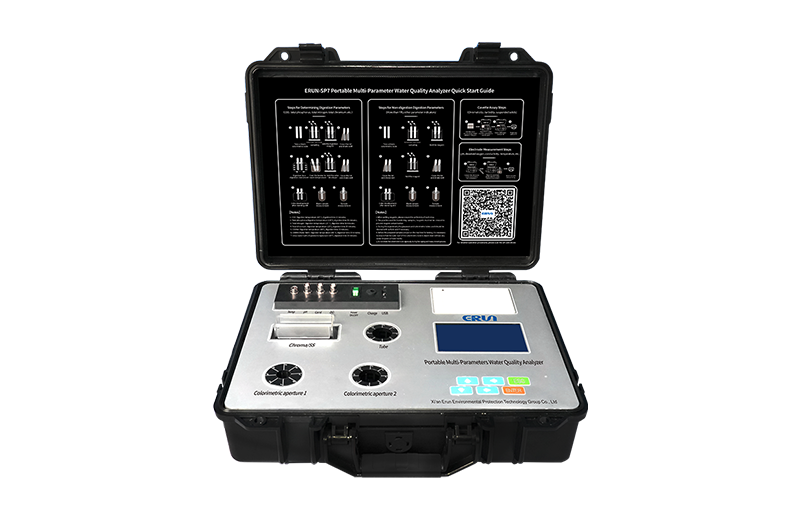
For professionals seeking a reliable and efficient solution, the ERUN-SP7-K6 Portable Residual Chlorine Water Quality Tester by ERUN Environmental Protection offers a comprehensive approach to on-site chlorine residual detection.
Designed around the colorimetric method, this portable tester integrates advanced optoelectronic technology to deliver high-precision measurements with an accuracy of ±0.01 mg/L. Its measurement range of 0.02–10.00 mg/L makes it suitable for both low-level drinking water monitoring and higher industrial applications.
What sets the ERUN-SP7-K6 apart is its strong focus on usability and data reliability. Automatic wavelength selection eliminates manual calibration steps, while the cold light source and narrow-band interference optical system ensure excellent optical stability over time. This combination minimizes drift and enhances repeatability, even in demanding field conditions.
From a data perspective, the instrument is built for modern water management needs. It can store up to 200 factory curves and 100,000 data records, supports user-defined calibration curves, and includes a one-key recovery function to protect critical data. The large LCD screen, rechargeable lithium battery, USB data transfer, and optional printing capabilities further enhance operational efficiency.
The ERUN-SP7-K6 is widely applied across municipal water supply systems, food and beverage processing, medical and pharmaceutical facilities, and petrochemical industries, making it a versatile and authoritative tool for safeguarding water quality and regulatory compliance.
Residual chlorine detection is not limited to a single point of use. It plays a vital role throughout the entire water lifecycle:
l Source water treatment
l Distribution networks
l Industrial process water
l Final point-of-use verification
Portable, high-accuracy instruments allow professionals to respond quickly to fluctuations, identify risks early, and maintain consistent water safety standards.
Chlorine residual detection is a cornerstone of effective water quality management. By understanding detection methods, recognizing the importance of accurate monitoring, and applying best testing practices, organizations can protect public health, ensure compliance, and optimize water treatment processes. With advanced portable solutions like the ERUN-SP7-K6, accurate on-site residual chlorine measurement becomes not only achievable, but efficient and dependable across a wide range of applications.