


Ozone is widely used in water treatment because of its strong oxidation and sterilization ability. However, improper ozone concentration can cause safety risks, process instability, and compliance issues. That is why understanding how to test for ozone in water accurately is essential for water treatment operators, industrial facilities, and environmental monitoring professionals.
This article explains the most reliable ozone testing methods, how to choose the right solution, and why portable multi-parameter testing is becoming the preferred option for modern water quality management.
Ozone (O₃) is a powerful oxidant that dissolves in water and is commonly used for disinfection, deodorization, and oxidation of organic and inorganic contaminants. Ozone-treated water is widely applied in drinking water systems, wastewater treatment, food processing, and industrial circulation water.
Because ozone is unstable and decomposes quickly, its concentration can fluctuate significantly. This makes ozone in water testing a critical task rather than a one-time measurement.
Testing ensures that ozone levels are effective but not excessive. Insufficient ozone leads to poor disinfection, while excessive ozone may damage equipment, affect downstream processes, or violate safety standards. Accurate ozone water test methods help operators maintain process stability, meet regulatory requirements, and protect both people and equipment.
Municipal and industrial drinking water systems rely on ozone for disinfection. Monitoring ozone concentration ensures water safety while preventing harmful byproducts or residual ozone exposure.
Industries such as power generation, chemical processing, and wastewater treatment require continuous ozone control. Reliable ozone analyzer for water solutions are essential for stable production and environmental compliance.
Not all testing happens in a laboratory. Field engineers and operators often need fast, on-site data, making portable testing solutions increasingly important.
Colorimetric testing uses chemical reagents that react with ozone to produce a color change. While this method is easy and low-cost, it is sensitive to interference and human error. It is best suited for quick checks rather than precise control.
Electrochemical sensors measure ozone concentration through an electrical response. These sensors offer higher accuracy than colorimetric methods but require regular calibration and maintenance, especially in harsh environments.
UV methods provide high precision and are commonly used in laboratories. However, they are expensive, complex, and not suitable for on-site or mobile testing, limiting their practical use in daily operations.
Portable detectors combine ozone measurement with other water quality indicators. For users managing complex water systems, this approach simplifies testing and improves efficiency by delivering multiple parameters in one device.
Different applications require different accuracy levels. Drinking water and industrial systems often need precise control, making professional-grade instruments essential.
If testing must be done frequently or in multiple locations, portability becomes a decisive factor. A portable water quality detector reduces delays and operational costs.
Ozone rarely exists alone. Measuring ozone together with chlorine, ammonia nitrogen, turbidity, or heavy metals provides a complete picture of water quality and process performance.
Many customers struggle with fragmented testing workflows, using separate devices for ozone, chlorine, nutrients, and metals. This increases costs, training time, and data inconsistency.
The ERUN-SP7 portable multi-parameter water quality detector is designed to solve this problem. Instead of managing multiple single-function instruments, users can rely on one flexible platform.
The ERUN-SP7 supports ozone in water testing alongside ammonia nitrogen, total phosphorus, total nitrogen, residual chlorine, total chlorine, chlorine dioxide, turbidity, color, and a wide range of heavy metals and inorganic salts. More importantly, test parameters can be expanded and customized based on actual monitoring requirements.
For customers in water treatment plants, industrial facilities, or environmental monitoring agencies, this means fewer devices, faster testing, and more consistent data.
Its portable design allows on-site testing without sacrificing accuracy. Whether used for routine inspections, emergency checks, or process optimization, ERUN-SP7 helps users make faster and more informed decisions.
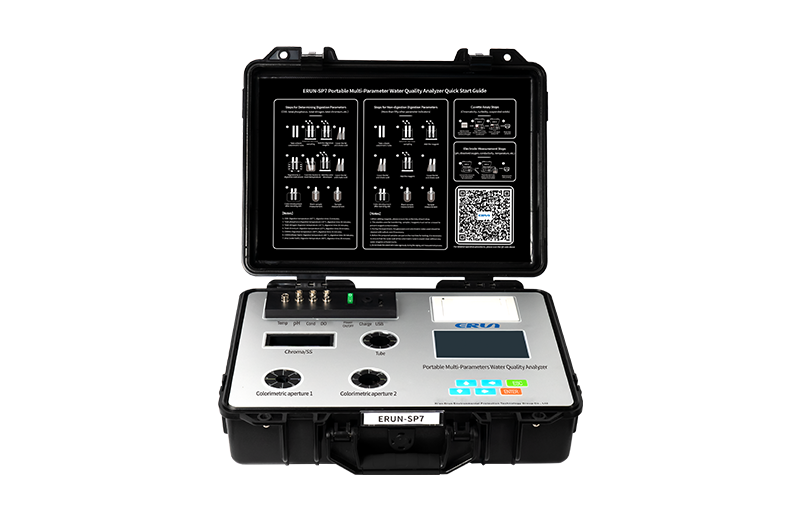
Water samples are collected and analyzed directly on-site. The detector processes the sample and displays ozone concentration within minutes, eliminating the need for laboratory delays.
Regular calibration, proper sample handling, and routine maintenance ensure reliable results. Using a multi-parameter water quality analyzer also helps cross-check data for better interpretation.
Compared to single-parameter instruments, ERUN-SP7 reduces equipment costs and simplifies operation. Unlike laboratory-only methods, it supports real-time field testing, making it ideal for dynamic water systems.
For organizations managing complex water quality requirements, a portable water quality detector offers both flexibility and long-term value.
Understanding how to test for ozone in water is essential for safety, compliance, and process control. While traditional methods still have their place, portable multi-parameter solutions represent the future of water quality monitoring.
By combining accuracy, flexibility, and expandability, ERUN-SP7 provides a practical and efficient solution for professionals who need reliable ozone testing without complexity.