


Ozone has become an increasingly important disinfectant in modern drinking water treatment. Compared with traditional chemicals, it offers powerful oxidation, high disinfection efficiency, and fewer harmful byproducts. However, ozone must be precisely controlled and accurately measured to ensure both water safety and regulatory compliance.
This article explains what ozone is in drinking water, how it is used, whether it is safe, and how water treatment professionals can monitor ozone effectively using reliable testing solutions.
Ozone (O₃) is a highly reactive form of oxygen composed of three oxygen atoms. In drinking water treatment, ozone is generated on-site and injected into water as a disinfectant and oxidizing agent.
Because ozone is unstable and decomposes quickly back into oxygen, it does not leave a long-lasting residual in the distribution system. This property makes ozone both highly effective and highly sensitive, requiring careful monitoring during treatment.
Ozone is significantly more powerful than chlorine when it comes to inactivating microorganisms. It effectively destroys bacteria, viruses, and protozoa such as Giardia and Cryptosporidium, which are resistant to some traditional disinfectants.
Ozone helps remove unpleasant tastes, odors, and color caused by organic matter, iron, and manganese. This makes it especially valuable for improving overall drinking water quality.
Unlike chlorine, ozone does not form chlorinated disinfection byproducts such as trihalomethanes (THMs). This makes ozone an attractive option for utilities aiming to meet stricter drinking water regulations.
When properly controlled, ozone is safe and widely accepted in drinking water treatment across many countries.
Drinking water authorities typically regulate ozone indirectly by controlling treatment dosage and ensuring ozone residuals break down before water reaches consumers. Excessive ozone exposure, however, can cause operational risks and material degradation in pipelines.
Because ozone reacts quickly and disappears rapidly, operators cannot rely on estimation alone. Accurate on-site measurement is essential to ensure:
Effective disinfection
Protection of downstream infrastructure
Compliance with water quality standards

Measuring ozone presents unique challenges due to its instability. Common approaches include:
This method uses reagents that react with ozone to produce a measurable color change. It is widely used for field testing due to its simplicity and speed.
These methods provide higher sensitivity and are suitable for on-site and laboratory environments where precise control is required.
Because ozone decomposes quickly, samples cannot be stored or transported for long periods. Portable, multi-parameter water quality detectors are therefore ideal for real-time monitoring directly at treatment sites.
In municipal drinking water treatment, ozone does not work in isolation. Its performance is closely related to other water quality parameters, such as:
Turbidity
Residual chlorine
Organic load
Metal ions like iron and manganese
If these parameters fluctuate, ozone demand and effectiveness change accordingly. Without comprehensive monitoring, operators risk either under-dosing (insufficient disinfection) or over-dosing (safety and cost issues).
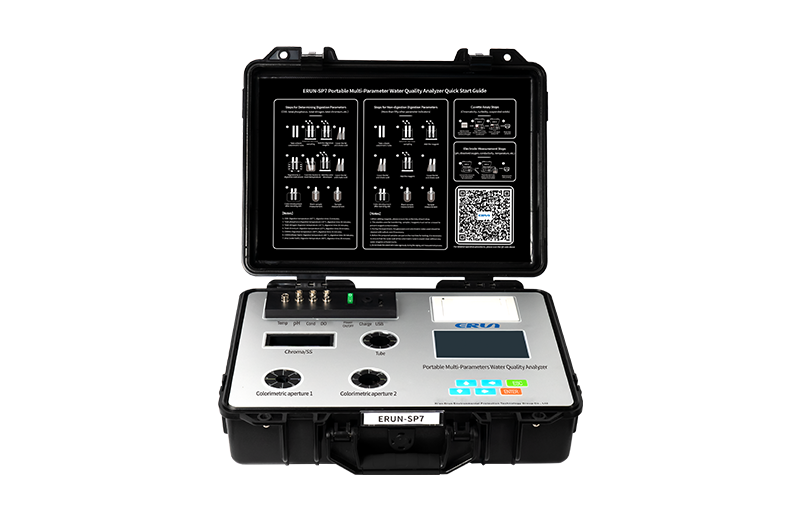
Municipal water plant operators need a solution that is fast, accurate, flexible, and easy to use on-site. The ERUN-SP7 portable multi-parameter water quality detector is designed to meet these exact needs.
Instead of relying on multiple single-parameter instruments, ERUN-SP7 allows operators to monitor ozone alongside other critical water quality indicators in one device, improving efficiency and decision-making.
Supports ozone and disinfectant-related parameters, including residual chlorine, total chlorine, and chlorine dioxide
Enables rapid on-site testing, eliminating delays caused by sample transport
Helps operators adjust ozone dosage in real time to maintain safety and compliance
Portable and field-ready, ideal for treatment plants, pipelines, and inspections
Expandable test parameters, covering ozone, turbidity, nutrients, metals, hardness, and more
Built-in data storage and printer, allowing operators to record, track, and report results instantly
Designed for regulatory compliance, process optimization, and operational efficiency
For drinking water facilities managing complex treatment processes, ERUN-SP7 provides a complete monitoring solution, not just a testing instrument.
When selecting ozone monitoring equipment for drinking water, professionals should consider:
Measurement accuracy and stability
Ability to test multiple parameters
Portability for on-site use
Data management and reporting capabilities
Multi-parameter instruments like ERUN-SP7 are especially valuable for modern water plants seeking cost-effective and scalable solutions.
Ozone is a powerful and effective disinfectant that plays a vital role in improving drinking water safety and quality. However, its benefits can only be realized through precise control and reliable monitoring.
By using advanced, portable testing solutions such as the ERUN-SP7, drinking water professionals can ensure proper ozone application, maintain compliance, and deliver safe, high-quality water to the public.