


Sodium ion contamination is one of the most critical water quality risks in nuclear power plants. Even trace-level sodium ions (ppb level) can indicate condenser leakage, resin failure, or external contamination, which may quickly lead to corrosion, scaling, or stress corrosion cracking in high-pressure systems.
Understanding how to test for sodium ions accurately is, therefore, a core requirement for nuclear power plant water chemistry control. In this article, we explain common sodium ion testing methods, relevant nuclear standards, and introduce a laboratory-grade solution designed specifically for ultra-low sodium monitoring.
In nuclear power plants, sodium ions are considered indicator contaminants rather than primary constituents. Their presence often signals more serious underlying problems.
Sodium ions usually enter the system through:
Condenser tube leakage (seawater or cooling water ingress)
Ion exchange resin exhaustion
Chemical dosing errors or raw water intrusion
Because sodium salts are highly soluble, they can travel quickly throughout the water-steam cycle.
When sodium ions combine with chlorides or sulfates, they can:
Increase electrical conductivity
Accelerate localized corrosion
Promote stress corrosion cracking in steam generators and piping
Even concentrations at the ppb level are enough to cause long-term damage under high temperature and pressure.
For this reason, nuclear plants require:
Extremely low detection limits
High stability measurements
Continuous or frequent laboratory verification
Several analytical techniques are used to test sodium ions, but not all are suitable for nuclear applications.
Flame photometry is simple and fast, but has drawbacks:
Higher detection limits
Sensitive to sample matrix interference
Less suitable for ultra-pure water testing
Ion chromatography offers high accuracy, but:
Requires expensive equipment
Involves a longer analysis time
It is not ideal for routine daily monitoring
Sodium ion-selective electrodes (ISEs) are preferred because they:
Detect sodium at ppb levels
Provide fast, direct readings
Works well with ultra-pure water samples
While exact limits vary by region and system design, nuclear plants typically apply very strict sodium control thresholds.
Common guideline values include:
Condensate: ≤ 5–10 μg/L (ppb)
Feedwater: often even lower
Steam generator systems: near-zero tolerance
Sodium ion testing is commonly performed in:
Condensate polishing outlet
Boiler feedwater
Make-up water systems
Online monitors provide early warnings, while laboratory static testing ensures accuracy and verification.
Sodium ion-selective electrodes respond selectively to Na⁺ activity in solution.
The electrode generates a potential difference proportional to sodium ion concentration, which is converted into readable values via calibration curves.
Key factors include:
Electrode cleanliness
Temperature stability
Sample purity and preparation
Regular electrode cleaning and conditioning are essential to maintain stable and repeatable results.
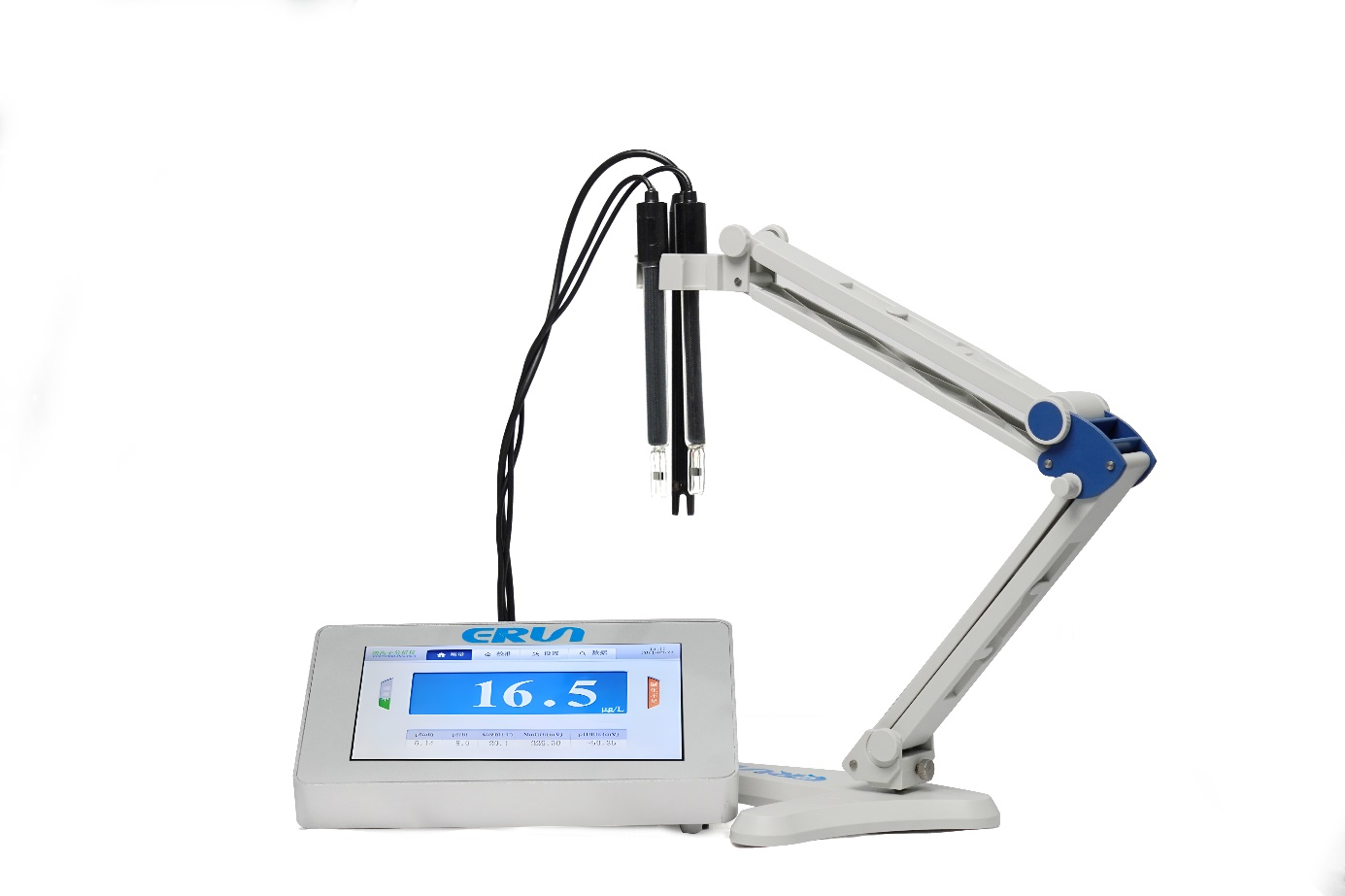
The ERUN-ST3-M6 desktop sodium ion analyzer, developed by Erun Environmental Protection, is designed specifically for high-precision laboratory sodium ion detection, including nuclear power plant applications.
This instrument is optimized for:
Ultra-low sodium concentrations (ppb level)
Static beaker measurements
Laboratory-grade stability and repeatability
Compared with older analog sodium meters, ERUN-ST3-M6 offers:
Intelligent digital display
Improved measurement stability
Easier operation and data reliability
With correct electrode cleaning and handling, the analyzer delivers consistent and accurate results suitable for nuclear water chemistry control.
Specialized sodium ion electrodes for ppb-level detection
Enhanced performance in static laboratory measurements
Suitable for continuous monitoring across industries such as:
Nuclear and thermal power
Chemical and fertilizer
Environmental protection
Tap and ultrapure water systems
Use clean, contamination-free containers
Avoid contact with glassware containing sodium residues
Calibrate using low-level sodium standards
Allow electrode stabilization before measurement
Inadequate electrode cleaning
Temperature fluctuation
Poor sample handling
When selecting a sodium ion analyzer, nuclear facilities should prioritize:
ppb-level sensitivity
Measurement stability
Proven electrode performance
For laboratory environments, desktop analyzers like ERUN-ST3-M6 provide higher accuracy and control compared with portable devices.
Contact me for more product details:
WhatsApp: +86 181 8913 5710
Email: [email protected]
Sodium ion detection plays a vital role in protecting nuclear power plant water systems from corrosion and contamination. Among the available methods, sodium ion-selective electrode technology remains the most practical and reliable choice for monitoring ultra-low concentrations.
With its enhanced intelligent design and laboratory-grade precision, the ERUN-ST3-M6 desktop sodium ion analyzer provides a reliable solution for sodium ion detection in nuclear power plants and other high-purity water applications.