


Suspended solids are one of the most important indicators for evaluating water quality in wastewater treatment, industrial discharge, drinking water sources, and environmental monitoring. Yet many people still confuse what they are, why they matter, and how to measure them accurately.
This guide explains everything you need to know about suspended solids—definitions, sources, impacts, measurement methods—and why advanced multi-parameter instruments like the ERUN-SP9 are becoming essential in modern water analysis.
Suspended solids (SS) refer to tiny solid particles that do not dissolve in water and remain “floating” due to water turbulence. They include:
Silt and clay
Organic debris
Microorganisms
Industrial particles
Wastewater treatment residues
These particles can be visible or microscopic. When measured through filtration and drying, the result is recorded as Total Suspended Solids (TSS) in mg/L.
Soil erosion
Organic biomass from rivers and lakes
Algal growth
Industrial waste discharge
Municipal wastewater
Construction site runoff
Food processing, textile, and chemical manufacturing
Understanding the source helps determine proper treatment strategies.

Suspended solids are far more than “dirt in the water.” They directly influence:
High SS results in turbidity, reducing visibility and causing consumer complaints in drinking water.
Organic solids consume dissolved oxygen during decomposition, harming aquatic life.
Heavy metals, nutrients, and toxins often bind to suspended particles, increasing treatment complexity.
Solids cause clogging, abrasion, and faster wear in pumps, filters, and pipes.
Wastewater discharge permits usually include strict TSS/Turbidity limits that industries must meet.
Filter water
Dry the residue
Weigh the filter
Offers high accuracy but requires lab conditions and time.
Uses how particles scatter light to estimate suspended solids.
Fast, field-ready, and widely used in modern monitoring.
Suitable for continuous monitoring in wastewater treatment plants and industrial discharge outlets.
Each method has pros and cons, but optical measurement combined with multi-parameter analysis offers the best balance of convenience and data depth.
Suspended solids don’t exist alone—they affect and are influenced by other water indicators:
Turbidity reflects particle concentration
Conductivity & TDS reveal dissolved substances interacting with solids
Dissolved Oxygen (DO) decreases when organic solids degrade
pH influences particle dissolution or coagulation
For complete water analysis, you must assess multiple parameters at once.
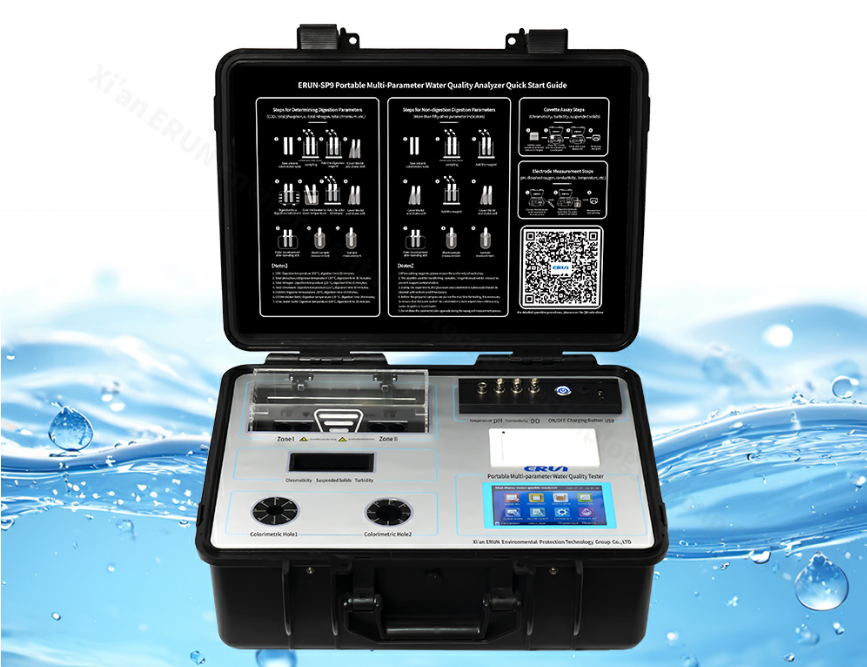
To address modern water monitoring needs, the ERUN-SP9 portable multi-parameter tester provides a powerful solution.
Advanced optical 16-channel design
Enables rapid, accurate detection of suspended solids and more than 60 water quality parameters.
Multi-parameter capability
Combines optical and electrode methods to measure:
Suspended solids
pH
Conductivity
TDS
Salinity
And dozens of additional chemical/physical indicators
Customizable parameter configurations
Users can freely combine testing items depending on project requirements.
Field-ready performance
Portable structure, strong stability, ideal for wastewater plants, research labs, environmental monitoring units, and industrial process control.
With ERUN-SP9, suspended solids monitoring becomes faster, more comprehensive, and more convenient than traditional lab-only methods.
Effluent quality control, clarifier performance assessment.
Monitoring discharge compliance for food processing, textile, chemical, and metal industries.
River, lake, and ocean turbidity and sediment transport studies.
Ensuring clarity and maintaining filtration system efficiency.
Ecology, hydrology, and sedimentation research projects.
Suspended solids are a key water quality parameter affecting clarity, ecology, compliance, and equipment lifespan. Accurate and efficient monitoring is crucial for both environmental protection and industrial operations.
Modern instruments like the ERUN-SP9 make suspended solid analysis easier, faster, and more comprehensive by integrating multi-parameter capabilities into one portable device.
If your work involves wastewater, industrial discharge, or environmental monitoring, integrating high-precision SS measurement into your workflow is no longer optional—it’s essential.