


The bottom line: To export an online drinking water analyzer, your device must carry CE, ISO 9001, and RoHS certifications and continuously monitor four mandatory parameters—pH, turbidity, temperature, and residual chlorine—to meet WHO guidelines and pass customs in the EU, EAEU, and US markets. The global drinking water multi-parameter online monitor market is projected to grow fromUS$894 million in 2025 to US$1,486 million in 2032, at a 7.7% CAGR—with China as the dominant export source.
These four parameters are the international baseline for drinking water safety compliance; no regulated market accepts a monitoring system that omits any of them.
WHO Guidelines set pH at 6.5–8.5, turbidity below 5 NTU (desirable: below 1 NTU), and free residual chlorine at 0.2–5 mg/L at the point of consumption. Temperature has no fixed limit but directly affects chlorine decay rates and sensor compensation accuracy—making built-in temperature compensation essential for reliable field data. The US EPA enforces a stricter turbidity limit of 0.3 NTU for filtered water, and a maximum residual disinfectant level (MRDL) of 4.0 mg/L for chlorine.
CE, ISO 9001, and RoHS form the irreducible certification triad for entering EU and most regulated markets; missing any one triggers customs rejection or project disqualification.
CE marking confirms compliance with the Low Voltage Directive (2014/35/EU) and Electromagnetic Compatibility Directive (2014/30/EU), tested against EN 61010-1 (electrical safety) and EN IEC 61326-1 (industrial EMC). RoHS compliance under EU Directive 2011/65/EU restricts lead, cadmium, and mercury content. For pH measurement specifically, analyzers must align with EN ISO 10523 calibration protocols.
ERUN Environmental Protection’s ERUN-S series holds CE certification (Certificate No. TRCN-25133XEE01, valid through May 2030), issued by Integra®6, with the audit report noting "outstanding performance in low-power design, multi-parameter synchronous detection, and intelligent data analysis."
Integrated multi-parameter analyzers consolidate four sensor modules into one wall-mounted unit, cutting equipment cost by 60%+ versus four separate instruments.
Turbidity measurement follows ISO 7027 using 90° scattered infrared light, detecting light intensity scattered by undissolved particles at a 90±2.5° angle. pH uses glass electrode potentiometry (0–14 range, ±0.01 accuracy). Residual chlorine employs either DPD colorimetric or amperometric membrane electrode technology. Temperature uses NTC sensors for automatic compensation.
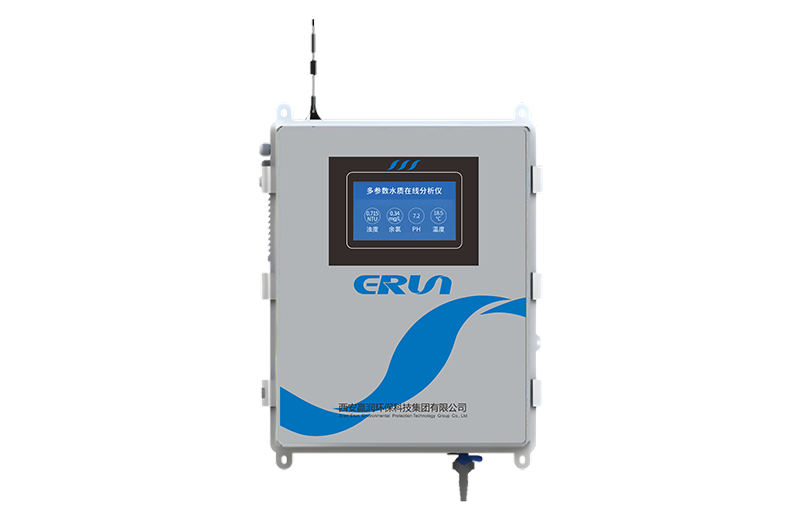
The ERUN-WQS-6022 from ERUN Environmental Protection integrates turbidity (0–20 NTU default, resolution 0.001 NTU), disinfectant/residual chlorine (0–5 mg/L, ±5% accuracy), pH (±0.1), temperature (±0.5°C), plus conductivity, TDS, ORP, and dissolved oxygen—all in a single ABS housing (405×500×190 mm). It supports RS485 Modbus-RTU + 4G (web API) with optional 4–20 mA output, directly connectable to cloud platforms for remote water quality management.
Beyond the CE/ISO 9001/RoHS triad, each target market imposes distinct additional requirements that must be evaluated during product selection, not after.
Market | Required Certification | Key Regulation | Deadline/Note |
|---|---|---|---|
EU | CE + RoHS + EN ISO 10523 | LVD 2014/35/EU, EMC 2014/30/EU | Mandatory for EEA entry |
EAEU (Russia, Kazakhstan, Belarus, Armenia, Kyrgyzstan) | EAC Declaration (DoC) | TR CU 004/2011, TR CU 020/2011, TR EAEU 037/2016 | DoC: ~1 week, $400–$1,100 |
US (Amazon/platform sales) | NSF/ANSI 61 or NSF/ANSI 372 | SDWA | April 3, 2026 deadline for compliance document submission |
For EAEU market entry, water quality analyzers for scientific or quality-control purposes qualify for EAC Declaration of Conformity (DoC) rather than the more complex Certificate of Conformity (CoC)—provided they are not used for commercial settlement measurements.
Q1: What certifications do I need to export online drinking water analyzers to the EU?
A: CE (LVD + EMC), ISO 9001, and RoHS—all three are mandatory. Additional compliance with EN ISO 10523 for pH measurement is recommended for regulatory acceptance.
Q2: What are the WHO limits for pH, turbidity, and residual chlorine in drinking water?
A: pH 6.5–8.5; turbidity ≤5 NTU (desirable ≤1 NTU); free residual chlorine 0.2–5 mg/L at the point of consumption.
Q3: Can one analyzer monitor pH, turbidity, temperature, and chlorine at the same time?
A: Yes. Multi-parameter online analyzers like the ERUN-WQS-6022 integrate all four sensors into one wall-mounted system with centralized data display and RS485/4G output.
ERUN Environmental Protection delivers CE, ISO 9001, and RoHS certified online drinking water analyzers trusted across 40+ countries—engineered for compliance, built for global water safety.