


The ERUN-SP6-4 portable multi-parameter water quality analyzer delivers accurate on-site measurement of COD, ammonia nitrogen, total phosphorus, and total nitrogen—with CE, ISO 9001, and RoHS certifications ensuring global regulatory acceptance.
For environmental monitoring teams, wastewater treatment operators, and drinking water quality inspectors, the ability to test multiple critical parameters on-site—without sending samples to a lab—saves time, reduces costs, and enables real-time decision-making. The global portable water quality analyzer market reached USD 2 billion in 2025 and is projected to grow to USD 3.68 billion by 2035, driven by increasing demand for field-deployable testing solutions.
A portable multi-parameter water quality detector eliminates the need for laboratory testing by delivering accurate, on-site measurements of key water quality indicators in minutes.
Traditional water quality testing requires collecting samples, transporting them to a laboratory, and waiting hours or days for results. This approach is not only time-consuming but also introduces risks of sample degradation and contamination. Portable analyzers solve this problem by bringing the laboratory to the water source.The ERUN-SP6-4 supports simultaneous determination of COD, ammonia nitrogen, total phosphorus, and total nitrogen—four of the most critical parameters for assessing water pollution levels.
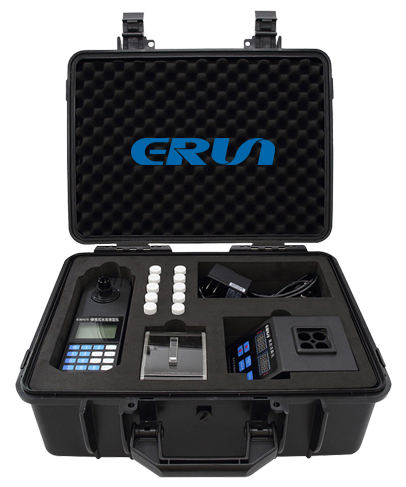
A high-quality portable water quality tester can measure COD, ammonia nitrogen, total phosphorus, total nitrogen, pH, turbidity, conductivity, and more—covering both chemical oxygen demand and nutrient pollution indicators.
The ERUN-SP6-4 offers the following measurement ranges and accuracy specifications:
Parameter | Measurement Range | Indicating Error |
|---|---|---|
COD | 5 – 2,000 mg/L | ≤ ±5% |
Ammonia Nitrogen | 0.02 – 25 mg/L | ≤ ±3% (F.S.) |
Total Phosphorus | 0.00 – 10 mg/L | ≤ ±5% (F.S.) |
Total Nitrogen | 0.05 – 100 mg/L | ≤ ±5% |
The instrument uses a cold light source with a narrow-band interference optical system for stable optical performance.Wavelength coverage includes COD at 420nm and 610nm, ammonia nitrogen at 420nm, total phosphorus at 700nm, and total nitrogen at 340nm.
Field water quality testing with the ERUN-SP6-4 achieves accuracy comparable to laboratory methods, with COD indicating error ≤±5% and ammonia nitrogen ≤±3% (F.S.).
The instrument's precision is ensured through several design features: a temperature PID automatic control system maintains digestion temperatures with ±0.5℃ accuracy; optical stability keeps light absorption value drift below 0.002A over 20 minutes; and reproducibility is ≤3%.The digestion temperatures are precisely controlled: COD at 165℃, total phosphorus at 120℃, and total nitrogen at 125℃, with digestion times of 15 minutes for COD and 30 minutes for phosphorus and nitrogen.
A globally credible water quality analyzer must carry CE certification for EU market access, ISO 9001 for quality management, and RoHS for environmental compliance—all of which the ERUN-SP6-4 holds.
CE certification confirms compliance with EU safety, health, and environmental protection mandatory requirements.ISO 9001 certification demonstrates adherence to international quality management standards. RoHS compliance ensures the product is free from restricted hazardous substances.These certifications are essential for customs clearance, regulatory acceptance, and building trust with international buyers.
The ERUN-SP6-4 is designed for rugged field use with a separation of digestion instrument and tester, multiple power options, and a durable ABS housing.
Key field-ready features include:
Separated design: The digestion instrument operates independently from the tester, ensuring measurement accuracy is not affected by the digestion process.
Power flexibility: Operates via built-in lithium battery, automobile cigarette lighter, portable lithium battery, or 220V power supply—eliminating the challenge of finding conventional power in remote locations.
Battery life: The host features a high-capacity rechargeable lithium battery that can last up to half a year on a single charge.
Durable construction: The main unit casing is made of molded ABS material with excellent corrosion resistance, waterproofing, and dustproofing. The high-strength carrying case is both aesthetically pleasing and durable.
Data management: 30 standard curves and storage for 199 measured values (including concentration with time stamps, absorbance, and transmittance). USB interface enables data upload and printing.
Portable water quality analyzers are essential for environmental monitoring, wastewater treatment, drinking water quality inspection, industrial water management, and emergency response.
Common applications include:
Environmental monitoring: Assessing surface water and groundwater quality
Wastewater treatment: Monitoring influent and effluent quality at treatment plants
Drinking water safety: Verifying compliance with drinking water standards
Industrial water management: Quality control in manufacturing and processing
Emergency response: Rapid assessment after pollution incidents or natural disasters
The instrument operates reliably under ambient temperatures of 5–40℃ and relative humidity up to 85%, with minimal vibration and electromagnetic interference requirements.
Select a portable water quality tester based on the parameters you need to measure, required accuracy, field conditions, and certification requirements.
Consider these factors:
Parameter coverage: Ensure the device measures all parameters relevant to your application—COD, ammonia nitrogen, total phosphorus, and total nitrogen are critical for wastewater and environmental testing.
Accuracy requirements: Verify that the instrument's error specifications meet your regulatory or quality standards.
Field conditions: Consider power availability, portability needs, and environmental durability.
Certifications: Confirm CE, ISO 9001, and RoHS compliance for international use.
Data management: Look for data storage, USB connectivity, and curve calibration capabilities.
Q: Can this analyzer measure drinking water quality?
A: Yes, the ERUN-SP6-4 is suitable for drinking water quality testing, measuring parameters such as pH, turbidity, conductivity, ammonia nitrogen, and COD that are critical for ensuring safe drinking water.
Q: What is the difference between portable and benchtop water analyzers?
A: Portable analyzers are designed for field use with battery power, rugged construction, and compact size. Benchtop analyzers offer higher throughput but require laboratory settings.
Q: How long does it take to get results?
A: COD digestion takes 15 minutes, while total phosphorus and nitrogen digestion takes 30 minutes. Measurement readout is nearly instantaneous after digestion.
Q: Is training required to operate this device?
A: The ERUN-SP6-4 features an LCD large-screen display with intuitive operation, minimizing the learning curve. Basic training on sample preparation and digestion procedures is recommended.
Q: What is the warranty and after-sales support?
A: Contact Erun Environmental directly for warranty terms and technical support at WhatsApp: + (86) 18189135710 or [email protected].
Erun Environmental—your trusted partner in portable water quality analysis solutions, delivering precision, reliability, and global compliance since day one.