A complete guide to dual-channel fluorescence sensing for water quality professionals
Harmful algal blooms (HABs) are among the most pressing challenges facing water resource managers today. Cyanobacteria—commonly known as blue-green algae—can produce toxins that threaten drinking water safety, aquaculture operations, recreational waters, and entire aquatic ecosystems. With projections showing an increase in the frequency and intensity of blooms due to climate change and nutrient pollution, early detection has become a top priority worldwide.
Traditional laboratory methods such as microscopic examination, high-performance liquid chromatography (HPLC), and bench-top flow cytometry are time-consuming, expensive, and impractical for field deployment. Fluorescence-based sensing has emerged as the solution of choice—and the most effective approach combines blue-green algae (phycocyanin) and chlorophyll-a detection in a single instrument.

Why Dual-Channel Detection Matters
Chlorophyll-a is a photopigment found in all phytoplankton, serving as a general indicator of total algal biomass. Phycocyanin (PC), on the other hand, is a pigment specific to cyanobacteria. By measuring both parameters simultaneously, a dual-channel fluorometer does what single-parameter instruments cannot: it differentiates cyanobacteria from green algae and calculates the PC:Chl-a ratio—a powerful predictor of bloom risk. Industry experts suggest that ratios above 0.5 indicate elevated cyanobacterial dominance, and ratios exceeding 1.0 signal a developing bloom threat.
The fluorescence method works by emitting excitation light at specific wavelengths—typically 470 nm for chlorophyll-a and 590 nm for phycocyanin—and measuring the characteristic emission peaks. Chlorophyll-a naturally absorbs blue light and emits red fluorescence, while phycocyanin emits at a distinctly different wavelength. This spectral discrimination enables real-time, species-level differentiation without sample preparation, delivering results in seconds rather than days.
Market Outlook: A Growing Global Demand
The global algae online monitoring market reflects the accelerating need for these technologies. Valued at approximately US$$191 million in 2025, the market is projected to reach U$$322 million by 2032, growing at a compound annual rate of 7.8%. Within this expanding landscape, optical fluorescence sensors—particularly those targeting both chlorophyll-a and phycocyanin—represent the fastest-growing segment, driven by regulatory requirements for drinking water source protection, high-density aquaculture management, and basin-wide environmental monitoring programs.
The ERUN-SP8-ASC: Dual-Channel Fluorescence in a Multi-Parameter Platform
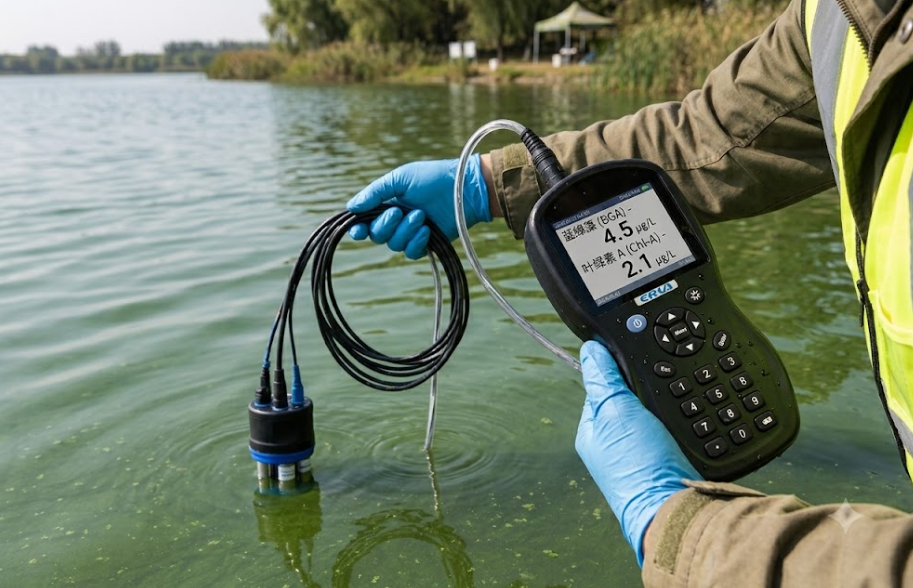
For water quality professionals seeking a reliable, cost-effective solution, the ERUN-SP8-ASC Portable Integrated Multi-Parameter Water Quality Analyzer from Erun Environmental Protection Group offers a compelling answer. This instrument is equipped with dedicated dual fluorescence channels for both chlorophyll-a and blue-green algae, enabling simultaneous measurement of these two critical parameters. Core Algae Detection Specifications
Chlorophyll-a detection: Fluorimetric method; measurement range 0–500 μg/L; resolution from 0.01 to 0.1 μg/L; accuracy at the 1 ppb rhodamine B dye signal level corresponds to ±5% of the value.
Blue-green algae (phycocyanin) detection: Fluorimetric method; measurement range 200–300,000 cells/mL; resolution 25 cells/mL; accuracy corresponds to ±10% of the value.
Multi‑Parameter Capability
Beyond its core algae-sensing capabilities, the ERUN-SP8-ASC simultaneously measures up to seven parameters in a single deployment, including:
Temperature, pH, ORP
Conductivity, salinity, TDS
Turbidity, dissolved oxygen
Optional sensors for ammonia nitrogen, nitrate nitrogen, chloride ion, fluoride ion, and sludge concentration further expand its versatility.
Rugged Field Design
The instrument is engineered for real-world field conditions:
Handheld operator unit: 3.5-inch color display, 8 GB data storage, built-in GPS receiver
Connectivity: Bluetooth, Windows-based PC software (data download, curve display, calibration)
Environmental rating: Sensor probe IP68 (submersible to 30 meters); handheld unit IP67
Reliable operation in wet, harsh outdoor environments
Key Applications
Drinking water source monitoring: Early warning of cyanobacterial toxins before they reach treatment plants.
Aquaculture management: Real-time tracking of algae composition to prevent oxygen depletion and fish losses.
Reservoir and lake surveillance: Long-term unattended monitoring of eutrophication trends.
Environmental research and education: Rapid field assessments with laboratory-grade accuracy.
Recreational water safety: Timely detection of bloom conditions to protect public health.
The Bottom Line
As cyanobacterial blooms become more frequent and severe, fluorescence-based sensors are no longer a luxury—they are an essential standard tool for water environment projects worldwide. The ERUN-SP8-ASC delivers the dual-channel sensing capability you need, packaged in a rugged, portable, multi-parameter platform that works where you need it: in the field, in real time, without the laboratory bottleneck.
Learn more about the ERUN-SP8-ASC Portable Blue-Green Algae & Chlorophyll-a Sensor